
Company

1. In an old children’s book that I read many times when I was young, and still read for comfort in anxious times, the main character drops a knife while setting the table and remembers an old saying: “If you drop a knife, then company is coming.”
2. In late fall, shorter days and falling temperatures prompt the local crows to convene their family groups into a murder. The murder roosts in the valley along Seneca Creek overnight and flies west in a long, trailing cloud each morning to wherever they spend their day. Every evening, they seem to materialize out of the western sky, ribboning back across the farm to the creek bottom.
In the spring, when the pressures of cold and scarcity ease, the murder fractures and the crows go their own way for the spring and summer, separating into loose, raucous family groups. This time of year, around the equinox, is when ‘our’ crow returns to visit or to haunt us, bestowing the folklorically dubious gift of her company on our household.
In truth, of course, I have no way of knowing if this is the same crow year after year. In fact, I can’t be certain it is the same crow from one day to the next. But something about the way she looks at us — head cocked to the side, glossy black body alert but relaxed — and the positions she returns to — a certain branch in the black walnut tree, her almost invisible nest at the very top of the white pine, the warm asphalt shingles of the eastward-slanted roof of our house on a chilly morning, the particular spot at the northeast corner of the big red barn — make me believe, without proof, that she is our familiar, the crow that has visited every spring for the past few years.
She seems to enjoy selecting items from the compost pile outside the horse fence, hopping from the top of the pile to the bottom with one black eye on her intended treasure and one on the approach from the house. She washes her finds in the horse trough. This angers my daughter, but the crow cares not a bit for her frustration. She scurry-flaps to the corner of the barn roof when my daughter shoos her away, but her mission is accomplished: her food is clean and hydrated, any loose crumbs or soil left behind to float on the surface of the trough.
The crow visits us every day during the spring and summer. I suspect that she has eggs and fledglings in the nest, and probably an extended family of young adult relatives close by. But as the old saying goes, we never see a baby crow, or even a fledgeling. Young crows have brown feathers on the edges of their wings and tail, but she is fully black, not a feather out of place. She is a fish crow, so her two-part call is nasal and abrupt, staccato and insistent. You can forget about her for days if you are lost in thought as you come and go from the house, but she will remind you of her presence one morning with a sharp rebuke and you will realize that she has been there all along.
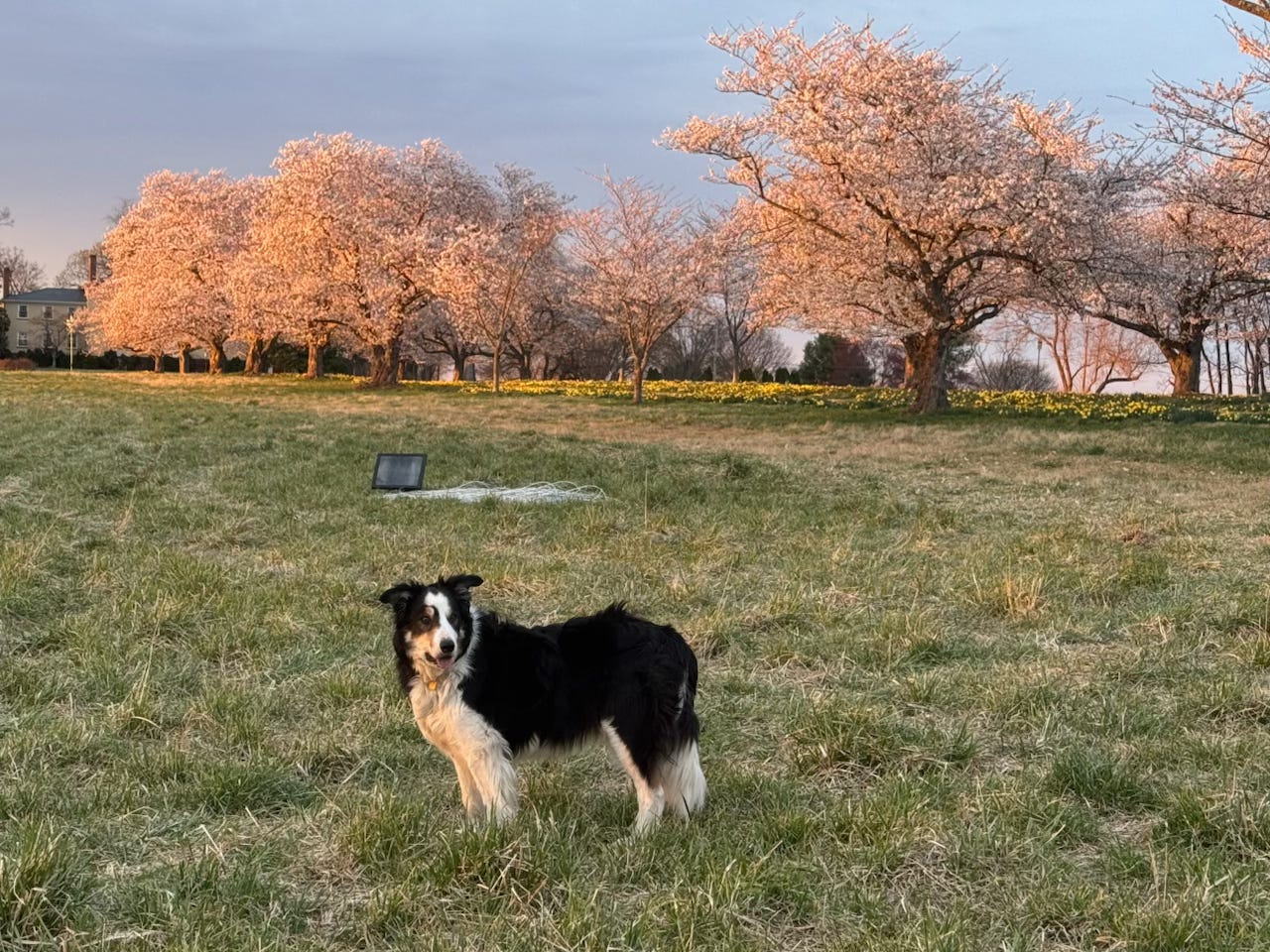
3. I hear more helicopters now than I used to. Our farm sits one mile from the Potomac River and directly in the flight path to Dulles airport in Virginia. All day and all night, with the exception of the eerie and profound silence during the pandemic, we hear the rising and falling roar of jet engines passing over. Sometimes they are so low that we can read the company name on the belly of the plane.
We are accustomed to the plane noise, which can put a stop to video calls and make hollering across the pasture impossible during peak hours. Most of the time, except for these minor inconveniences, we don’t notice it. But lately, the steady thwack-thwack of helicopter rotors, sometimes following the path of the river, sometimes heading north over the farm or flying low west to east from horizon to horizon, has caught my attention more often than I remember in years past.
Living where we do, we’ve always heard helicopters. In normal times, the Marine convoy carrying the President to Camp David often passes over the farm. One summer evening in 2019, an old Huey made an emergency landing in the field just west of us. It was a crew from the 1st Helicopter Squadron out of Joint Base Andrews, tasked with evacuating critical members of the government in the event of an emergency, and with transporting “distinguished persons” around the Washington area in normal times. This was a training flight, or an exercise of some kind: no distinguished persons were on board.
The cabin was spare and utilitarian, all black vinyl jumpseats and analog, gunmetal gray fixtures and equipment. The crew were young and competent and polite and kind. We brought them hamburgers and puppies to snuggle and they pitched their hammocks in the steeplechase judges’ stand and stayed with the helicopter all night until a repair team arrived to trailer it back to Andrews. They tolerated our visits through the night along with the small crowds of locals that gathered to ask them the same questions over and over again.
These charged and dangerous days, the sound of helicopters puts me on edge. Rationally, I know there is no immediate threat. We are safe, and so much more fortunate by accident of birth and privilege than many in the world as I write this. But there are threat sensors, perhaps activated during the pandemic and never fully soothed, that are stoked in me now by the visceral whap whap whap of the rotors. They have a martial character to them, a determined authority that brooks no resistance or conversation. They do not seem to follow established roads or flight paths, but buzz across the landscape at unpredictable times and heights with increasing and disorienting frequency. I used to see them as benign, even heroic: medical transports landing in a field to transport victims to a trauma center or Coast Guard rescues assisting beleaguered vessels. Now they feel ominous, faceless, vaguely unfriendly.
4. “If a crow caws near your house, a guest will arrive: one for sorrow, two for mirth, three for a wedding, four for a birth.”
5. Last night we went down to the C&O canal at sunset to look for some necklaces my daughter dropped while running. We started at Pennyfield Lock and my daughter and husband went upriver while I, misunderstanding the assignment, turned downstream. I swept my headlamp back and forth over the gravel path as the light faded. At the lockhouse there is an old gate that stands partially open now to let the river water the canal, but the sound of the water rushing in quieted as I walked until the only sounds were the murmur of the river, the rasp of my shoes on the path, and the low trilling of a multitude of creatures in the canal.
It was not the urgent chorus of spring peepers that we’ve been hearing for the past month on any night that isn’t freezing or blowing. This was a slow, lazy warble that rose first from one spot in the canal, joined by another and another at dissonant intervals to the first, rose to a crescendo, and drifted into silence. Still searching for the necklaces, I found myself waiting for the reedy quavers to resolve to unison or harmony. They had their own musical logic, languid and unknowable.
I turned back upstream at a bend in the towpath where sandstone cliffs fall sharply to the surface of the canal. I could just make out the white blur of the lockhouse in the twilight, but I could not see my family’s headlamps through the gloom. As I started to walk back, still swinging my light back and forth in front of my feet, the croak of a of a great blue heron stilled the chirping in the canal as the huge bird flapped overhead, searching for a roost for the oncoming night.
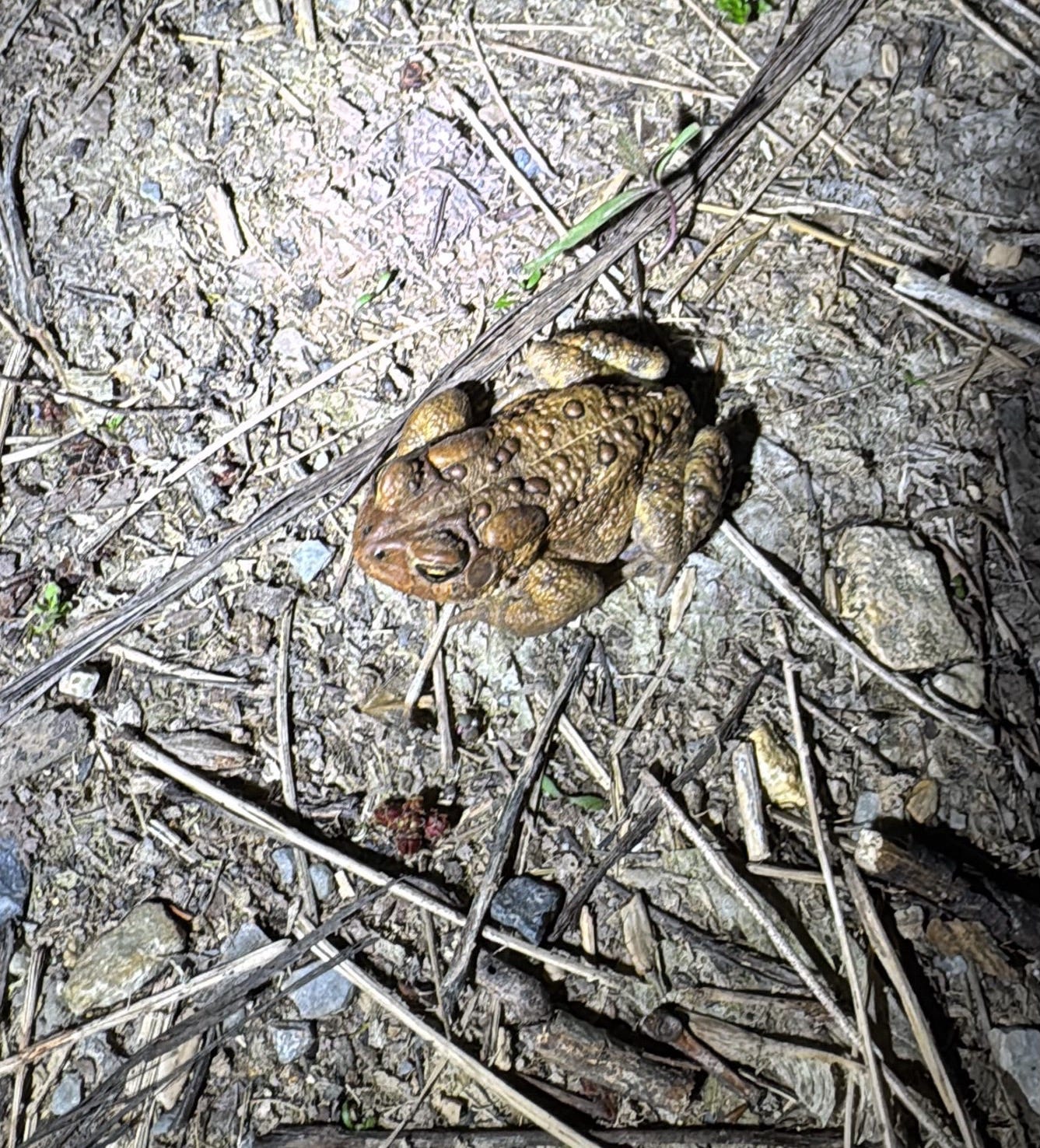
There was a rustle in the sycamore leaves to my left, between me and the river. A muffled splash came from the black canal waters to my right. All at once my light picked out a stone in the path that I knew had not been there on my way downstream. It was about the size of a small lime, brown and lumpy, and as I approached it resolved itself into a toad.
Delighted, the necklaces forgotten, I crouched down and shone my light on it to take an identifying photo in case it was some wild and exotic species I’d never encountered before. The app was unequivocal: common American toad. As I watched, the toad gathered its legs under it in a pose familiar to anyone who has longed for a child’s pose at the end of a yoga class. Its bumpy, bronze-green skin was set off by a pale yellow stripe down its spine. It stared straight ahead, black eyes wet and unblinking.
Of course the languorous song I was hearing all around me belonged to this creature and its kin, knobby-bodied amphibians with every bit as much motivation to procreate as their tiny, shrilling hyla cousins. I was inordinately pleased to have solved the mystery, glad to have seen the toad, remembered what I was supposed to be doing and walked on, peering into the dusk for the shapes of my family ahead of me. Before long, a big sycamore leaf to my left whispered into the towpath and another toad emerged, exactly as if it had been birthed from that leaf and the soil beneath it. Another crept from the canal side of the path, and another. As I walked, light pointed down to avoid them, one toad after another crawled onto the path, their pace as leisurely as their song, which rose and fell and filled the growing darkness as they took shape under the stars.
The towpath was littered with them, each distinct, spotted and speckled and rough and chunky, like fallen leaves of brown and green scattered across the gravel. As I reached the lockhouse and saw my daughter’s headlamp bobbing towards me from upstream, I saw the first mating pair, the male’s front legs clamped firmly around the slightly larger female, his back legs assisting her as she hopped. Their apparently unchanging expressions made the whole process feel ancient and inscrutable and somehow hilarious. Inexplicably, I thought of a tandem bicycle.
There were pairs and solitary seekers everywhere in the grass as we walked back to the car. Hundreds — thousands — of toads on a warm spring night, surrounded by dry leaves and sparse new grass and the eternal motion of the big river down from the mountains to the bay. A bat flickered out of the big sycamore to feast on the little invisible flies that were appearing as the darkness fell. Nothing else happened today. Nothing of consequence, anyway.
I love this so much, Amanda! The interweaving of the interwoven, and the words you use to describe it all, make me want to dip back in over and over again.
Jim and I recently watched this. You and your family might appreciate it as much as we did. (You might also be able to find a version without ads!) I'm sure crows and ravens have their differences, but my guess is they are similar in how they pair off, tend and release their young, and defend their territories.
https://www.youtube.com/watch?v=7RGmh_C3Kyg